
Newark Airport Wait Times and Best Travel Times
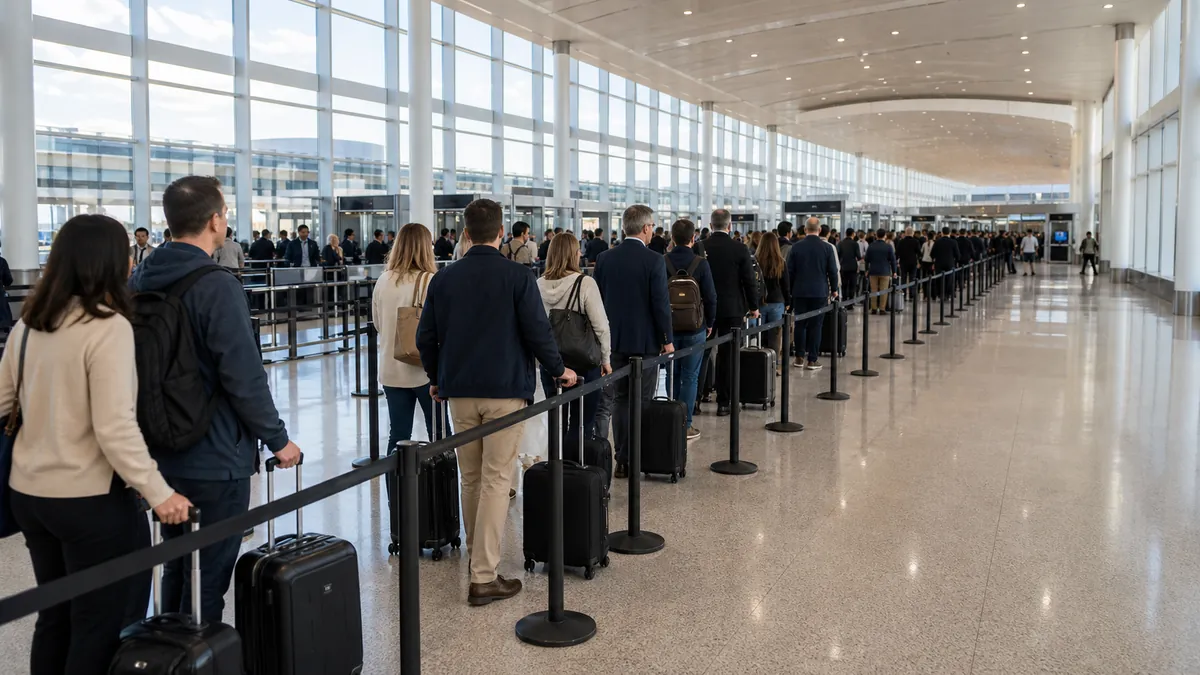
One Tuesday in February, a driver of ours dropped a client at EWR Terminal A at 5:40 AM for a 7:25 flight to Charlotte. The client texted later, slightly annoyed: he had cleared security in nine minutes and spent the next hour and a quarter at the gate with a coffee. The next morning, a different client, same drop-off window, same terminal, walked into a checkpoint line that wrapped past the food court. Same airport, same hour, twenty-four hours apart. Understanding Newark airport wait times is mostly about understanding why those two mornings were nothing alike, and how to land yourself on the right side of that coin flip more often than not.
Our team puts sedans, SUVs, and Sprinter vans into Newark Liberty every day of the year, and the question I field more than any other is some version of “how early do I need to leave.” There is a standard answer the airlines give, and there is a more useful answer that depends on your terminal, your day of week, your season, and whether you hold a trusted-traveler membership. This guide covers all of it. Not with a fake dataset or a study we made up, but with the patterns our drivers see from the curb and the feedback travelers bring back to me, framed against what the Transportation Security Administration and the Port Authority publish about how the airport behaves.
A quick note on what this page is and is not. It is a reference guide to typical wait patterns at EWR, written so you can plan a calmer trip. It is not a live tracker. Real-time numbers move hour by hour, and the last section points you to the official tools for checking them on your travel day. Treat the figures here as informed ranges, the kind of thing someone who works alongside a team at the airport six days a week would tell you, not precise guarantees.
| Time window | Standard line | PreCheck line | Notes |
|---|---|---|---|
| 4:30 to 5:15 AM | 5 to 15 min | Under 5 min | Calmest window of the day before staffing peaks |
| 5:15 to 8:00 AM | 20 to 45 min | 5 to 15 min | Morning business rush, the heaviest stretch most days |
| 10:00 AM to 2:00 PM | 10 to 25 min | Under 10 min | Midday lull, generally the most predictable window |
| 3:00 to 7:00 PM | 20 to 40 min | 5 to 15 min | Late-afternoon and early-evening rush builds again |
| After 8:00 PM | 10 to 20 min | Under 10 min | Eases off, though last-bank departures still draw a crowd |
Typical ranges observed across EWR checkpoints, May 2026. These are informed observations from daily trips, not a published dataset. Actual waits vary by terminal, day, and staffing. Check the official TSA tool before you travel.
TSA Wait Time Patterns by Day of Week
Newark airport wait times shift with the day of the week as much as they shift with the hour, and most travelers underestimate that. Newark is a heavy business-travel airport. United bases a major hub here, and the corporate calendar drives the rhythm of the checkpoints far more than leisure travel does. In our experience driving travelers to EWR, the week has a clear shape once you watch it long enough.
Monday mornings are the worst, reliably. Consultants flying out to client sites, sales teams heading to a Monday kickoff, finance people who spent the weekend home in New Jersey and now need to be in Chicago by lunch. The 5:00 to 7:30 AM band on a Monday at Terminal C, United’s home, is the single most crowded window our drivers see all week. Tuesday is nearly as busy. By Wednesday the morning rush softens a little, Thursday picks back up as people start heading home, and Friday afternoon turns into its own animal as the business week ends and the weekend leisure crowd arrives at the same time.
Saturday is the quiet day, generally. Fewer early-morning business departures means the dreaded pre-dawn line is shorter, though midday can still fill up with vacation travelers who all decided 11 AM was a civilized time to fly. Sunday is split: calm in the morning, then a steep build through the afternoon and evening as the return-trip business crowd and weekend travelers converge for Monday-morning meetings elsewhere. If you have any say in the matter, a midweek midday departure is the gentlest experience EWR offers.
One caveat we have learned to respect. Holidays and the days bracketing them throw the normal weekly shape out entirely. The Wednesday before Thanksgiving does not behave like a Wednesday. We will get to seasonal and holiday patterns further down, but keep it in mind: the day-of-week rule holds for ordinary weeks, and ordinary weeks are most of the year, just not all of it. For business travelers who do this every week, our corporate transportation in Newark desk builds pickup times around exactly these patterns, terminal by terminal, so the same client is not gambling on a coin flip every Monday.
Best Times to Arrive for Domestic vs International Flights
Once you understand Newark airport wait times by hour and by day, the next question is how to convert that into an arrival time at the curb. The standard guidance is the right starting point: arrive about two hours before a domestic departure and about three hours before an international one. The TSA and most airlines repeat that for a reason. It builds in a cushion for the checkpoint, for a slow check-in counter, for the walk to a far gate, and for the small disasters that travel days produce. We do not argue with it. We plan around it, and then we adjust for the specifics of EWR.
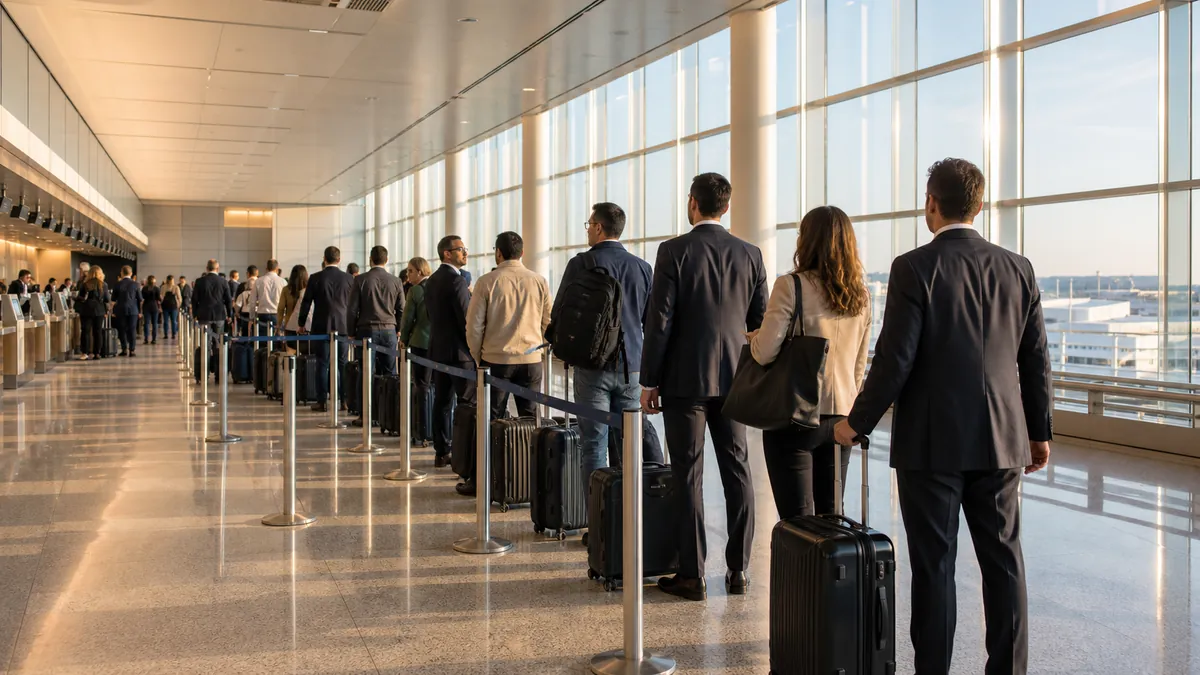
Domestic departures
For a domestic flight, two hours is the floor, not the target. If you are flying out of EWR during one of the rush windows, the 5:15 to 8:00 AM band or the 3:00 to 7:00 PM band, we tell clients to treat two hours as the bare minimum and lean toward two and a half. Here is how it adds up. A 35-minute checkpoint wait, plus a 15-minute bag drop, plus a 10-minute walk to a C3 gate, plus a buffer for anything going sideways, eats two hours quickly and leaves nothing for a coffee or a calm boarding. If you are traveling carry-on only and hold PreCheck, you can shave that, and we will cover trusted-traveler programs in the next section. If you are checking bags during a peak bank, do not cut it close.
Midday domestic departures are the forgiving ones. A 12:30 PM flight to Atlanta out of Terminal A, on a Wednesday, with a typical 10 to 25 minute standard line, can work on a two-hour arrival with margin to spare. The window counts for more than the two-hour rule itself.
International departures
Three hours for an international flight is sound advice at EWR, and we would not trim it. Terminal B handles most international carriers, and Terminal C handles United’s international long-haul. Arrivals on the busy EWR to LHR corridor can see longer CBP queues during the evening window when British Airways, Virgin Atlantic, and multiple European flights land within the same hour. International check-in adds steps a domestic trip skips: passport and document verification, sometimes a separate security queue, occasionally a longer walk to a far international gate. Bag-drop counters for international flights also tend to open on a fixed schedule rather than all day, so arriving very early does not always mean you can drop bags very early. Three hours absorbs all of that. For a peak-season international departure, we have clients who prefer three and a half, and we have never heard one complain about the extra half hour once they were through.
If you are connecting between airports rather than starting your trip at Newark, the timing math changes again, and minimum connection windows come into play. We break that down in detail on our EWR to JFK car service page, because a cross-airport connection has to account for two sets of wait times, not one, plus the drive between them. Crews who do this for a living think about connection timing constantly, which is why our airline crew transportation desk schedules around the same buffers.
Seasonal Patterns and Holiday Rush Data
Newark wait times are not constant across the calendar, and the seasonal swing is large enough that the same Tuesday-at-noon departure feels like a different airport in July than it does in late January. The broad shape, in our experience, looks like this.
Spring and summer are the busy half, and Newark airport wait times reflect that swing. School breaks, vacation travel, and a fuller flight schedule all push checkpoint volume up from roughly March through August. Summer Fridays are notably heavy. The shoulder months, late January into February and again in the stretch after Labor Day, are the calmest, when business travel carries most of the load and leisure travel thins out. Newark’s worst single days are not random; they cluster around the predictable holiday peaks.
| Period | Relative volume | What to expect at the checkpoint |
|---|---|---|
| Late Jan to mid-Feb | Lightest | Shortest lines of the year outside the morning business rush |
| Spring break (March) | Elevated | Family travel fills midday windows; mornings still business-led |
| Summer (Jun to Aug) | High | Fuller schedule; Fridays and Sundays the heaviest days |
| Thanksgiving week | Peak | Wednesday before and Sunday after are the busiest days all year |
| Late Dec holidays | Peak | The days around Christmas and New Year’s draw sustained crowds |
| Post-Labor Day | Light | Leisure travel drops; predictable, calmer checkpoints return |
General seasonal pattern at EWR based on our team’s day-to-day observation, not a published study. Holiday peaks shift with the calendar each year; the TSA publishes record passenger volumes around major holidays on its newsroom pages.
The holiday peaks deserve their own warning. The Wednesday before Thanksgiving and the Sunday after are, year after year, among the busiest travel days nationally, and Newark feels every bit of it. The TSA routinely screens record passenger volumes across those windows and says so publicly. The late-December stretch around Christmas and New Year’s behaves the same way, with the added wildcard of winter weather. On those days, the normal advice gets a hard upgrade: add a full hour to whatever you would normally plan, treat the two-hour domestic rule as three, and do not assume PreCheck saves you, because the PreCheck lane gets a holiday crowd too. We have watched the PreCheck line at Terminal C on the Sunday after Thanksgiving stretch to something that looked nothing like its usual five minutes.
Winter adds a separate variable that has nothing to do with crowd size. A snow event or an ice storm can collapse the schedule regardless of how short the security line looks, and a thin checkpoint on a bad-weather morning is cold comfort if your flight is delayed three hours. When our team sends a car out on a winter morning with weather in the forecast, flight tracking counts as much as wait-time planning. That is true whether you are coming from the suburbs or from one of the boroughs; our Brooklyn to Newark Airport car service clients face the same winter-morning math, just with a longer drive in front of it.
EWR Wait Times Compared to JFK and LaGuardia
Anyone weighing Newark airport wait times against the alternatives has, at some point, wondered whether the other airport would have been the smarter pick. It is a fair question, and the answer is that all three major airports here have busy checkpoints, and none of them is reliably painless. They are different airports with different shapes, though, and the differences are worth knowing.
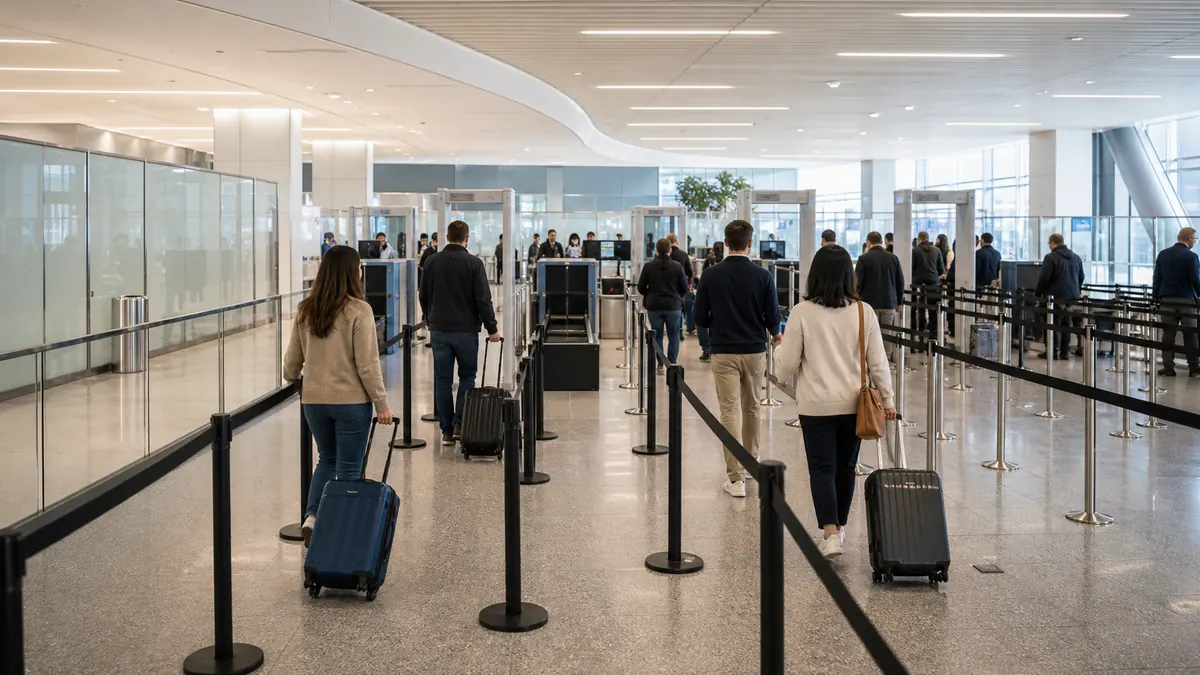
EWR is the most business-heavy of the three, which is why its weekly pattern is so pronounced. The Monday-morning and Sunday-evening peaks are sharper at Newark than at LaGuardia, where the traffic is a steadier mix. Newark’s three terminals, A, B, and C, spread the load, and the newer Terminal A has eased some of the pressure that the old facility carried for years. LaGuardia, after its full rebuild, moves better than its old reputation suggests, but it has no international long-haul to speak of and serves a domestic-heavy schedule. JFK is the international giant of the three, with eight terminals and a checkpoint experience that varies enormously from one terminal to the next; a wait at JFK Terminal 4 is a different story than a wait at Terminal 5.
What this means in practice: if you live or work in northern or central New Jersey, EWR is almost always the right call, and chasing a shorter line at JFK rarely pays once you add the drive across the region. The wait-time difference between the airports on any given day is usually smaller than the difference the drive makes. We say this as a Newark-focused service, so weigh it accordingly, but we also drive plenty of trips into JFK and we see both. If your trip starts closer to the other airports, the calculus shifts, and for travelers near the western suburbs our Princeton to Newark Airport car service still tends to favor EWR on total door-to-gate time even when JFK shows a marginally shorter posted wait.
| Airport | Profile | Peak pattern | Best for |
|---|---|---|---|
| EWR | Business-heavy, United hub | Sharp Mon AM and Sun PM peaks | North and central NJ travelers |
| LGA | Domestic, no long-haul | Steadier all-day volume | Domestic trips, NYC-side travelers |
| JFK | International giant, 8 terminals | Varies sharply by terminal | International long-haul, Brooklyn and Queens |
General comparison of the three major New York region airports, May 2026. Posted security waits change constantly; this table reflects typical structure, not a specific day.
How to Check Real-Time Wait Times Before Your Trip
Everything above is pattern and planning. On your actual travel day, you want the live Newark airport wait times for your terminal, and there are reliable ways to get them. The patterns tell you when to leave the house in general; the live tools confirm whether today is behaving normally.
The official starting point is the Transportation Security Administration. The TSA publishes checkpoint wait-time information through its website and through the MyTSA app, which lets you look up a specific airport and see historical and reported wait data by hour and day. It is the most authoritative source because it comes from the agency that staffs the checkpoints. The TSA also posts holiday travel volume forecasts on its newsroom pages ahead of the big peaks, which is worth a look if you are flying around Thanksgiving or the December holidays.
For airport-specific information, the Newark Liberty International Airport site, operated by the Port Authority of New York and New Jersey, carries terminal details, parking, and operational notices. The Port Authority’s own agency site is the place for broader regional travel advisories that can affect your trip before you ever reach the checkpoint. And for anything touching flight schedules and airspace conditions, especially around weather, the Federal Aviation Administration publishes a national airspace status page that shows ground stops and delays in real time.
A practical checking routine
Here is what we suggest, and roughly what our team does before a morning pickup. The night before, glance at the weather and the FAA status page if anything looks unsettled. The morning of, check the TSA tool for your terminal about three to four hours before departure, then again right before you leave the house. Confirm your flight status with the airline app at the same time. If the posted wait is well above the typical range for your window, leave earlier; if it is short, you still keep your planned cushion, because a posted number is a snapshot and lines build fast.
The one thing a live tool cannot do is account for your drive to the airport. A short security line is no help if you are stuck on the New Jersey Turnpike. That is the part we handle: flight tracking on every reservation, complimentary wait time built in, and drivers who know which EWR terminal entrance is moving on a given morning. If your trip starts in a group, our Sprinter van service keeps everyone on one vehicle and one timeline instead of three separate cars arriving at three different moments. Travelers coming from the Hudson County side can see the same planning on our Jersey City to Newark Airport car service page, and cruise passengers with a sailing to catch get an even tighter buffer through our EWR to cruise terminal car service.
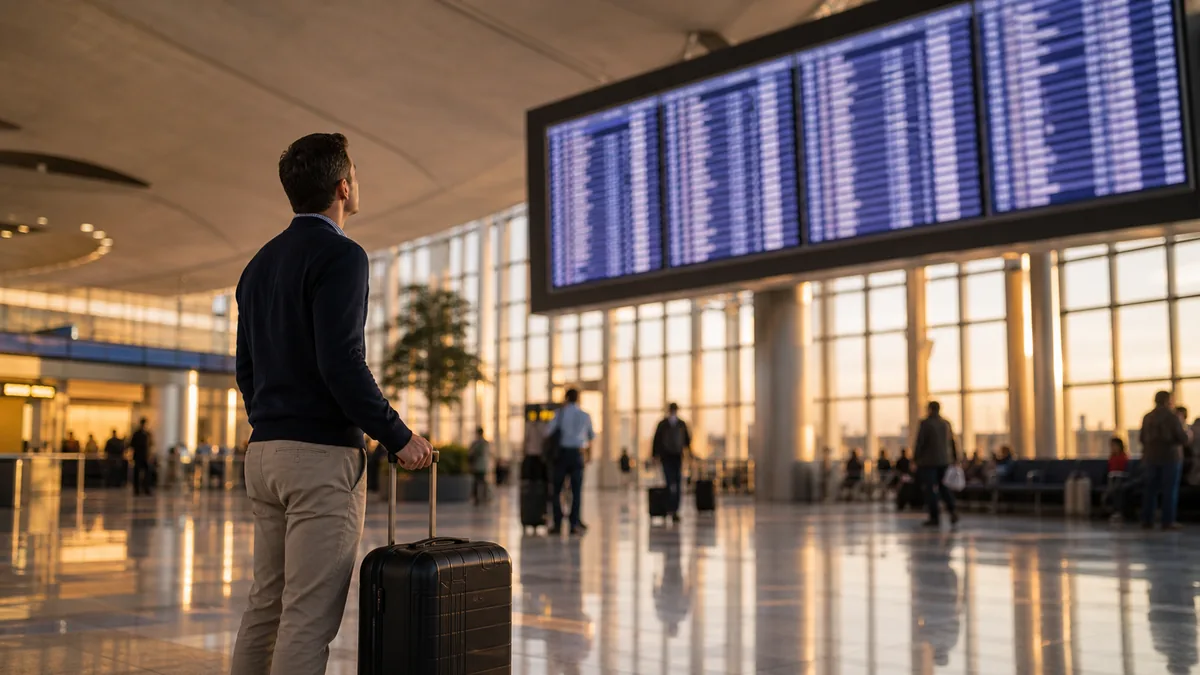
Trusted-traveler programs and how much time they save
TSA PreCheck and CLEAR both speed up the security step, and they do it differently. PreCheck is a TSA program that gives you a dedicated lane and lets you keep shoes, belt, and laptop where they are, which makes the screening itself faster and the line shorter most of the time. CLEAR is a separate private service that moves you to the front of the identity-verification step; many travelers pair CLEAR with PreCheck for the fastest combination. At EWR, in the morning rush, the gap between a standard line and a PreCheck line is at its widest, and that is exactly when the membership pays for itself.
Two caveats. First, PreCheck is not immune to crowds. During a holiday peak or a heavy Monday bank, the PreCheck lane can build its own line, and we have seen it. It is faster than standard, almost always, but it is not a guaranteed walk-through. Second, neither program helps with bag drop, document checks, or the walk to your gate. They speed one step. Plan the rest of your buffer as if they did not exist, and treat the time they save as margin, not as license to leave later. For executives who travel weekly, the membership plus a car with built-in flight tracking is the combination that removes the most uncertainty, which is the logic behind our Newark Airport limo service for clients who cannot afford a missed departure. In the end, Newark airport wait times reward the traveler who plans with the patterns, checks the live tools on the day, and leaves the drive to someone who watches the EWR checkpoints every morning.
Frequently Asked Questions
It depends heavily on the time of day. In our experience driving travelers to EWR, the standard security line typically takes 20 to 45 minutes during the morning rush, roughly 5:15 to 8:00 AM, and 20 to 40 minutes in the late-afternoon rush. Midday windows, around 10:00 AM to 2:00 PM, are usually calmer at 10 to 25 minutes. PreCheck lines are normally well under 15 minutes outside of holiday peaks. These are typical ranges, not guarantees, so check the official TSA tool on your travel day.
The standard guidance is about two hours before a domestic departure and about three hours before an international one, and that is the right starting point. At EWR we tell clients to treat two hours as a floor for domestic flights, leaning toward two and a half if you are flying during a rush window or checking bags. For international flights from Terminal B or C, three hours is sound, and during peak season three and a half is reasonable. Midday departures are the most forgiving and can work comfortably on the two-hour rule.
The midday window, roughly 10:00 AM to 2:00 PM, gives you the shortest Newark airport wait times and the most predictable, least crowded checkpoint. The very earliest departures, before about 5:15 AM, also tend to clear security quickly because you beat the morning business rush, though you trade that for a pre-dawn wake-up. The windows to avoid if you can are 5:15 to 8:00 AM and 3:00 to 7:00 PM, when business travel volume peaks. A midweek midday flight, on a Tuesday or Wednesday, is the gentlest combination EWR offers.
The most authoritative source is the TSA itself, through the tsa.gov website and the MyTSA app, which lets you look up EWR and see reported and historical checkpoint wait data by hour and day. The official Newark Liberty International Airport site, operated by the Port Authority, carries terminal and operational notices, and the FAA airspace status page shows ground stops and delays in real time. Our suggested routine is to check the TSA tool three to four hours before departure and again right before leaving the house, alongside your airline app for flight status.
Yes, in most cases meaningfully. TSA PreCheck gives you a dedicated lane and lets you keep shoes, belt, and laptop in place, so both the line and the screening itself move faster, and the gap from the standard line is widest during the morning rush. CLEAR is a separate service that speeds the identity-verification step, and many travelers pair the two. The caveats: during holiday peaks the PreCheck lane can build its own line, and neither program helps with bag drop or the walk to your gate, so plan the rest of your buffer accordingly.
The Wednesday before Thanksgiving and the Sunday after are, year after year, among the busiest travel days at EWR, and the TSA routinely screens record passenger volumes across that window. The late-December stretch around Christmas and New Year’s behaves the same way, with winter weather adding a wildcard. Summer Fridays and Sundays are the heaviest of the warm-weather months. On any of these peak days, add a full hour to your normal plan, treat the two-hour domestic rule as three, and do not assume PreCheck saves you, because that lane gets a holiday crowd too.